
As-Built Survey Plan: What Reviewers Need to Verify
An as built survey plan is the survey deliverable that records the measured location and elevation of constructed work against the approved design. Review it by confirming the receiving authority’s current checklist, survey certification, control and datums, last field date, measured differences, and required submission files before anyone makes a compliance decision.
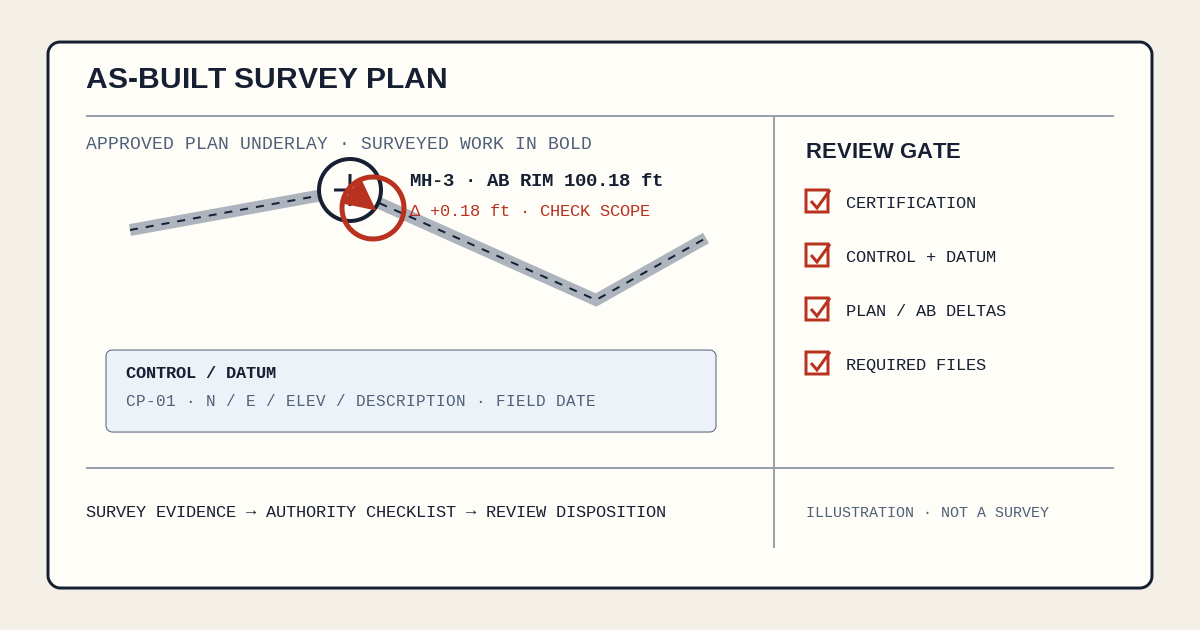
What makes an as-built survey plan different from redlines?
An as-built survey plan reports surveyed positions and elevations with the professional and technical notes required for that submission. Other project records may document construction changes. The receiving authority and contract determine whether those records are separate and whether one can accompany or substitute for another.
Orlando's As-Built Surveys page describes that city's review role and the definition it reproduces.
Orlando's Survey Section reviews as-built surveys for acceptance under its cited city standards; the page's definition concerns measured horizontal or vertical locations of completed improvements.
This describes Orlando's stated process. It does not supply a project tolerance, certification, datum, or nationwide submission rule.
Which authority requirements should you confirm before drawing?
The receiving authority’s current requirements determine who prepares the plan, what it shows, and how it is delivered. Make a requirement register from the primary checklist instead of carrying rules from a previous jurisdiction.
| Review field | Question for the primary source | Reviewer action |
|---|---|---|
| Base and display | Which approved plan revision is the comparison base? | Record the approved source revision |
| Professional | Which credential, signature, seal, and certification are required? | Check the named credential and certification coverage |
| Control record | Which horizontal system, vertical datum, units, and control references apply? | Trace each reported value to the control note |
| Digital package | Which files, forms, and delivery method does the receiver require? | Compare the actual package with the current instructions |
These Orlando HTML examples were checked on November 23, 2026, and apply only within their stated scopes. Check amendments, permit conditions, contract documents, and the receiver’s current page on the day of submission.
How do you check control, datums, and certification?
Check control, datums, and certification as one traceability block. A precise elevation cannot be compared safely when its vertical basis is missing or differs from the permitted design.
- Identify the design basis. Record the approved plan revision, horizontal system, vertical datum, units, and published control references.
- Read the survey basis. Find the same fields on the survey plan, along with the fieldwork date and the control points actually used.
- Resolve mismatches first. Hold numerical comparison if units, datum, adjustment, or control identity conflict. Do not hide a basis problem inside a tolerance result.
- Check certification coverage. Confirm the signer’s role, seal or signature method, sheets covered, purpose statement, and any required wording against the current authority rule.
Do not infer a coordinate system, datum, certification phrase, or field-date rule from Orlando’s short HTML survey page: it does not state those details. Obtain them from the current, accessible primary requirements that govern the actual project, and hold the comparison when that basis is missing.
How do you check the authority’s submission sequence?
Check package completeness separately from measured differences. The receiving authority's sequence determines when to send the initial files and when to supply later physical copies.
Orlando's permit-closeout instructions give a source-backed example.
Orlando's closeout page calls for an initial digital submission of PDF and CAD files, followed after review approval by two signed and sealed paper sets and digital files on two thumb drives.
Counting only the stated sets and drives gives 2 paper sets + 2 thumb drives = 4 physical items.
| Published stage | Published quantities | Count check | Claim limit |
|---|---|---|---|
| After digital reviews are approved | 2 signed and sealed paper sets + digital files on 2 thumb drives | 2 + 2 = 4 physical items | Counts only the stated sets and drives; it does not count files, forms, or letters |
The arithmetic verifies only the number of physical paper sets and drives named in that sentence. It does not show how many digital files belong on each drive, replace the separately listed checklist or certification letter, prove that a package is complete, or establish approval. It also supplies no design value, survey observation, governing tolerance, or disposition for a surveyed difference. Those still require the project records and complete applicable review.
For a deeper method on issue decisions, use the surveyed-change release gate. The point-ID crosswalk guide covers how to preserve the observation behind a structure label.
What belongs in a reusable survey-plan review worksheet?
A reusable survey-plan review worksheet should separate document completeness from measured differences and professional disposition. Copy the fields below, then replace every bracketed entry with the receiving authority’s current requirement.
| Document basis | Survey basis | Comparison row | Submission and decision |
|---|---|---|---|
| [authority / checklist date] [permit / plan revision] [required scope] | [surveyor / certification] [field date / units] [horizontal / vertical datum] [control points] | [asset / source point] [plan / survey value] [signed delta / cited limit] [evidence gap] | [PDF / CAD / references] [sheet and layer checks] [open / accepted / resolved] [reviewer / date / basis] |
This worksheet is an editorial artifact, not an AsBuiltReview feature or an authority form. It helps keep questions visible; it does not certify the survey.
Where can AsBuiltReview support the review?
AsBuiltReview can support a first-pass comparison after the reviewer has identified the correct source files and project rules. The tracked product source states: “An as-built review compares surveyed locations and elevations with the permitted design and the tolerance rules that apply to the job. AsBuiltReview automates that first pass for structures and pipes; a licensed engineer still confirms every finding.”
The AsBuiltReview features page says the product aligns LandXML or DXF permit drawings to CSV, XLSX, or LandXML survey data; compares structure offsets, elevations, pipe length, slope, and cover; and produces review outputs. It also says DWG is not accepted directly, starter limits are placeholders, and the product does not stamp, certify, or approve anything. This article’s worksheet, authority checks, and package-count example are not represented as product capabilities.
What do reviewers ask about an as-built survey plan?
These answers keep the survey deliverable separate from redlines and from the authority’s acceptance decision.
What is an as-built survey plan?
An as-built survey plan is a survey deliverable showing the measured location and elevation of constructed work in relation to the approved design, with the control, datum, field date, and certification required by the receiving authority.
Is an as-built survey plan the same as contractor redlines?
Not automatically. A survey plan reports measured positions and elevations under the applicable surveying and authority requirements. The receiving authority and contract determine whether separate construction-change records are also required.
Who signs an as-built survey plan?
The governing contract, jurisdiction, and professional-practice rules decide. Confirm the required credential, signature or seal, and certification language in the receiving authority’s current primary materials.
What should a reviewer check first?
Start with the current receiving-authority checklist. Confirm the approved plan revision, required survey scope, control and datums, certification, field date, file formats, and any project-specific tolerances before judging a measured difference.